
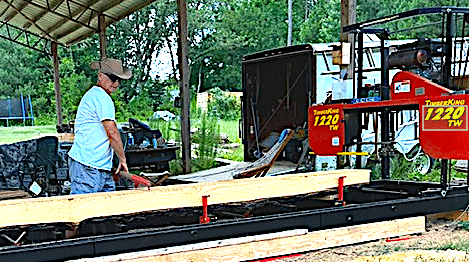
Don Hudson’s a hands-on guy. He has decades of experience in construction and cabinetmaking. But he’s NEW to sawing with his new TimberKing sawmill. In this article, he shares 21 tips on how he’s learning to saw quality lumber. Whether you’re a long-time sawyer, just getting started, or just thinking about getting a mill, there’s something here for you!
“For 45 years, I worked in construction as a builder and custom cabinetry maker. I’m retired now and just got a TimberKing 1220 sawmill. I’m very used to working with wood but I’m learning that there’s a world of difference between building homes and custom cabinetry and sawing lumber. Here’s some of what I’ve learned-by-doing!” — Don Hudson
DON’S 21 SAWMILL TIPS
1. I decided what I want to accomplish with a sawmill
I don’t intend to make money with my sawmill. My plan is to make lumber to do repairs to buildings here on our farm. We also want to put up a building at the back of our property. I don’t plan to saw for others but some relatives have already asked me if I could saw up some of their logs. I tell them, ‘If you want your logs cut into lumber, I’ll help, but you’ll do the work!’
2. Lumber quality depends on how I run the mill
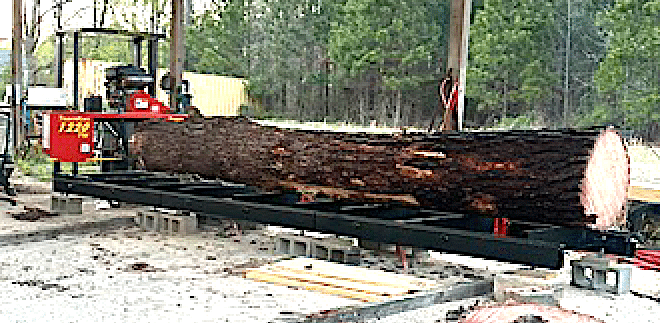
When I buy lumber at a supply house, it’s pretty perfect – straight, kiln dried, and the surfaces are planed. When I cut my own lumber, the quality is totally up to me, what I know, and how well I handle the mill.
3. Why I chose TimberKing’s 4-post head over mills with cantilevered heads
I’m not one to jump into quick decisions, so I thought about getting a mill for years. I was first drawn to a cantilever-style mill – the kind with the cutting head supported on just one side. But a relative has a 1600 TimberKing so I went to see it. The difference between the cantilevered head and the solid, 4-post TimberKing head is like apples and oranges. I imagine a one-post cantilever mill would wobble as it cuts. And over time, wobbling creates metal fatigue.
4. Why the 1220
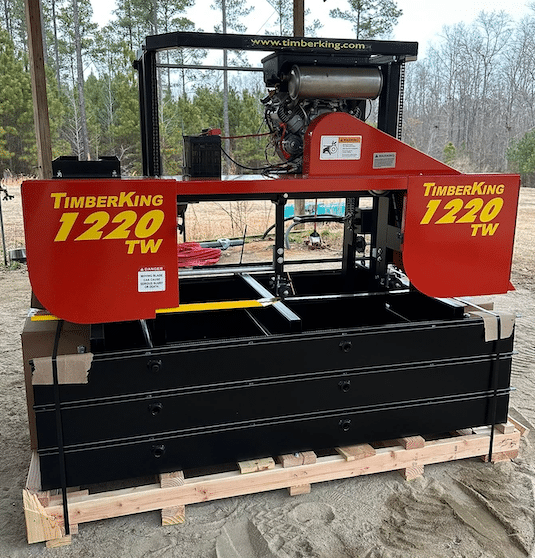
I chose the TimberKing 1220 for it’s pricing and because it fits the kind of sawing I want to do. Sure, I’d like a bigger mill but this fits what I need. This 1220 mill is well thought out. If you want a good, entry level mill with service and reliability, this is the one.
5. ‘Experience is the best teacher‘ – learn by doing
Learning to saw is a unique experience. I’m early in the process and certainly don’t know all there is to know, but I’m really enjoying learning-by-doing and going at my own pace. I’m learning how to work with the mill to get good, straight lumber.
6. I started with small timber
I started with small diameter timber — southern yellow pine and black walnut from our property. This is virgin timber with no nails. I moved on to larger logs as I gained experience.
7. Sharp blade = quality cut
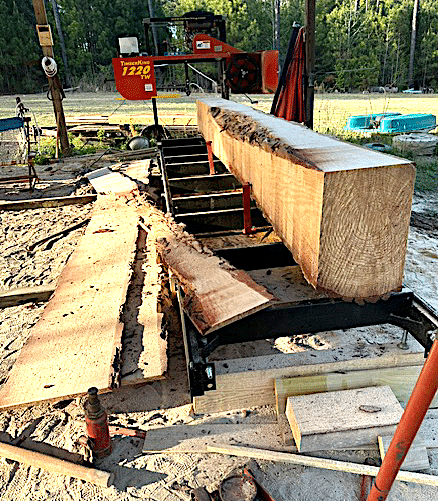
I want to get maximum life out of my saw blades. But I change blades in a timely manner because I’ve learned having a sharp blade makes a big difference in the quality of the cut.
8. I load logs small end toward the blade
I’m learning the right way to put logs on the mill — smaller end facing the cutting head. Having a big tractor as I do is a huge help.
9. How I minimize waste
It breaks my heart to see all the slabs, sawdust, and kindling sawing produces so I minimize waste where I can. For example, logs may measure the same diameter at both ends, so there’s little waste as I slice off the slabs. But logs often have a different diameters at each end. I level the log on the mill, splitting the difference between the two diameters. So if one end is 4” diameter bigger than the other, I raise the small end 2”. There’s less waste that way.
10. I saw off tree limb stubs before loading
I quickly learned to cut all the limbs off close to the log before loading. Otherwise, limb stubs can get caught on your log stops as you saw and you’ll have to back up the head and cut the stubs off with a chainsaw.
11. ’Sappy’ logs need extra lube
I cut my logs while they’re still fresh and ‘sappy.’ That means I’ve got to use plenty of blade lube. I added a second stopcock to the lube system so I could reach it easily.
12. I check first cut angle
Squaring up your log is a big deal. I’ve learned to take off the first slab, then turn the logs 90 degrees so the flat side rests tight against the log stops. Then I check the angle with a large framing square to be sure everything’s square and true. If the first flat side isn’t square to the log stops, your cant won’t be square and every board will be off, too.
13. I adjust cutting speed to fit the wood
The 1220 cuts great. It’s a manual mill; I turn the crank to advance the cutting head. Different woods cut best at different speeds. Because I’m cranking the head, I can easily see and feel how fast or slow to move the head. And I can slow down when I come up on a knot.
14. How I get precise cutting depth
A cantilever mill has a crank mechanism to set the depth of your cut. Turn the crank and a tab falls into a notch. I don’t think that could be a precise depth setting – I think it’s ‘glitter’ to catch a novice like me. TimberKing has a magnetic measuring strip you peel off and position where you want it. For example, I make the first cut and line up the strip’s ‘zero’ mark at that cut, then crank the head up to where the strip indicates whatever thickness I want the next board to be – 1” board, 1-1/2”, 2-9/16”, or whatever.
15. Steel cables are best
TimberKing uses a steel cable system to feed the cutting head. A cantilever mill uses a ROPE! It may be a high-tech rope, but it’s still a rope.
16. Joy of sawing
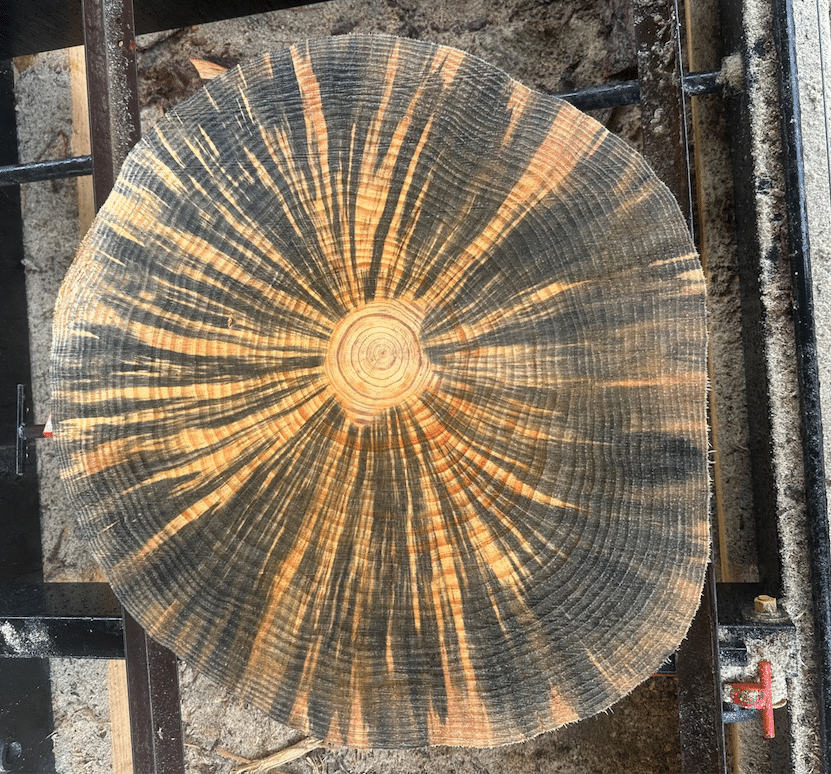
I find a lot of joy in sawing. One joy is in cutting my own trees into lumber and using the lumber to build things. I cut leftover log-ends into ‘cookies’ I use as knife-throwing targets. I’m cutting timbers for my wood shop. I milled the lumber for my 40 x 80’ sawing shed – 6×6”, 6×8”, 4×4”. I’m replacing T1-11 siding on my horse barn with 1×6 and 1×8 boards I’ve cut. I’m turning a beautiful walnut tree into a lovely cabinet for my wife.
17. Joy of saving money
Another joy is saving money cutting my own lumber. I’ve saved $5,000 – $6,000 NOT buying commercial lumber. And I’ve saved time and money NOT driving to Home Depot or Lowes when I need a 2×4.
18. Great way to stay fit
I’m 72 and physically fit. And I want to stay that way. Sawing is a workout. It makes me sweat, makes me feel good, and I don’t have to go to the gym!
19. TimberKing’s made in USA
Most mills are made overseas. TimberKing is made in America. I support that all day long. The company has been making sawmills a long time and they get good reviews about their equipment and their customer service. I’ve gotten great service, fast parts, and good advice from TimberKing.

20. Quick delivery
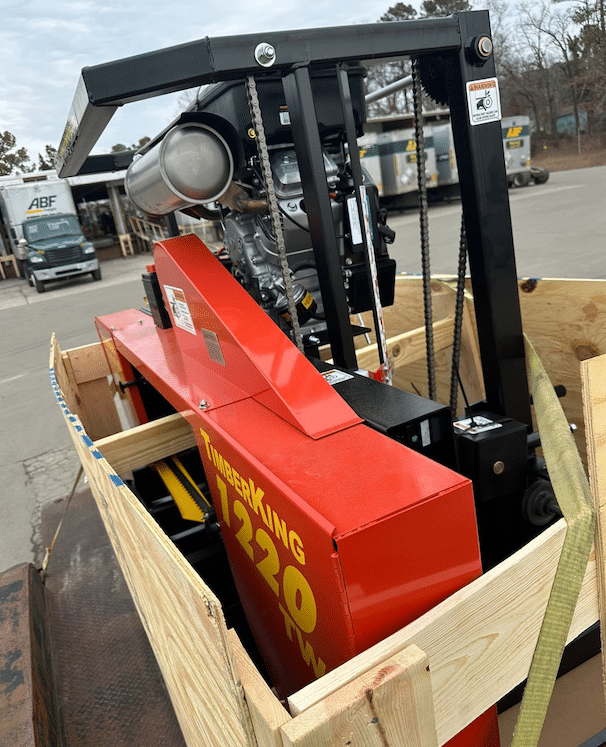
My mill was shipped to a depot where I picked it up. Delivery was quick, it was packed well, and setup was perfect. I have’t had any service problems. I have nothing but praise for TimberKing mills and TimberKing service.
21. Have fun sawing!
I’ve been in construction for a long time and I’ve had all kinds of equipment. I tell others if you buy cheap, you get cheap. Buy the best and it’ll last. Choose a mill based on what you’ll saw. Make sure you have a place to keep it out of the weather. Put it on a good foundation. TimberKing’s a great mill – go have fun sawing!”
— Don Hudson, TimberKing 1220 Owner, Archer Lodge, NC
HAVE QUESTIONS? 3 ways we can help you
• Call us 1-800-942-4406
• Email us [email protected]
• Visit us on Facebook