

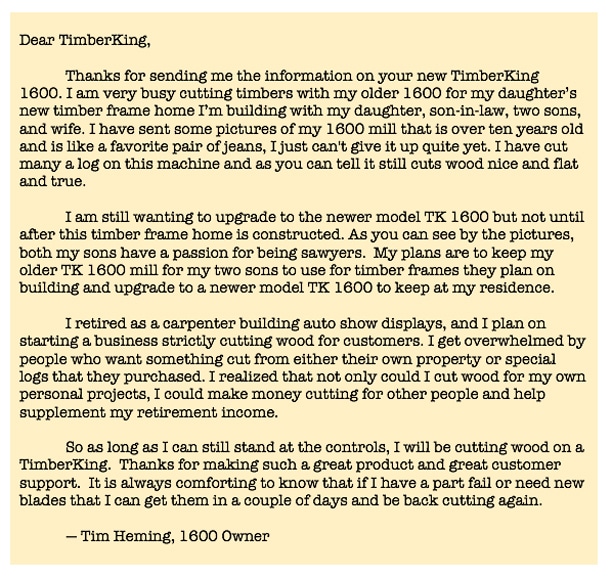
We at TimberKing received this email from one of our owners, Tim Heming. We were so interested in what he wrote us that we gave him a call to learn more about the home he’s building for his daughter, his sawing, and his future plans. Here’s the rest of Tim’s story…
“I’m used to doing big building projects. I was a union carpenter, the foreman of a crew building auto show displays. Now that I’m retired, I’m doing a lot of sawing with my 10-year old TimberKing 1600. A big current project is sawing out timbers and helping my daughter build an economical, energy-efficient timber frame home.

Boxing the heart
I bought 100, 16’ eastern white pine logs from a guy who was selectively cutting a farm field. The pines were nice, straight second and third growth trees. A log that’s 13” or 14” at the small end yields a beautiful 8 x 8 beam with no wane on the edges. With my TimberKing, I can cut perfect 90-degrees. You can throw a builder’s square on a beam and it’s right on. I’ve had my lumber graded and it’s select or #1. For the beams, I ‘box the heart’ to avoid checking. With logs that are 13” diameter or better, the heart is at the center of the beam and there’s no wane. I’m doing the joinery work now.

I started sawing in November of last year, sawing out a few logs at a time. Sawing slowed down a bit over the winter but we muscled through this spring and summer. I’ve sawn about 90 8×8 beams, purlins, 4 x 6 knee braces, and a lot of 5/4 boards for trim, and more. I’ve cut 3,000 board feet of 1” material for finished T&G V-groove paneling, casing, baseboard, shelving, brackets, and more.
Green beams
Working with a timber frame engineer, I’ve learned there’s no need to kiln dry the beams. We’ll be putting them up green. That’s the way it was done in the old days – the old-timers building barns and houses a hundred years ago weren’t waiting eight years for their beams to air dry!
Years ago, I built two homes using rough lumber from a mill. Then a friend bought a sawmill and I tried it. I ran a couple passes through the mill and I had to have one of my own. That’s when I got my first TimberKing 1600.

I looked at Wood-Mizer sawmills but why would anybody put a 500-lb motor, water tank, and more on top of a two-post ‘cantilever’ head that bounces? That bounce gives board what I call the ‘ocean effect’ – wavy cuts in the board’s surface. TimberKing’s 4-post head says it all – it’s heavy and solid. I can site right down the timbers, they’re cut straight.


Why not?
When my wife gives the OK, I’ll get a new 1600 TimberKing (or maybe a 2000) and start a retirement sawing business. I’ll probably be doing custom cutting and making live edge table slabs. And furniture. Why not start a business? I can be competitive. I may give my older 1600 to my sons and buy a new one that has new features like hydraulic toe boards, log stops, chain turner, and more.
What’s nice about TimberKing is, if I need a part, the company can get it to me by regular shipping in a couple days. Or overnight it if I need it fast. I buy my blades and parts from them. And they keep my name on file. They know what blades I buy and what works for me. I also have a Woodmaster Drum Sander – Woodmaster is TimberKing’s sister company.
One more thing about TimberKing: if you keep up on maintenance, and keep your blades sharp, this machine will outlast the person running it!”
— Tim Heming, TimberKing 1600 Owner, Metamora MI
HAVE QUESTIONS? 3 ways we can help you
• Call us 1-800-942-4406
• Email us [email protected]
• Visit us on Facebook