

Tom Bacon makes high-quality beehives with lumber he mills on his TimberKing sawmill. “I can saw exactly what I want,” he tells us. “And since I’m felling and milling my own trees, my cost-of-goods is far less since I’m not buying commercial lumber.”
“I started building homes at 16. At 18, I set out with just a backpack and tools and built homes across in several states. I joined the Army as a carpenter, became a Ranger, and was deployed to Afghanistan three times.

Today I’m married and we have two kids. I farm, garden, and raise some animals. And I make money in my bee business, Union Bee Company. My motto is, ‘Built for the Bees.’ I maintain 30+hives at our farm. And I sell honey, beehives, and bees!
Building a better beehive
I always wanted to keep bees. As a lifelong carpenter and woodworker, I saw there are serious flaws in the quality and design of modern Langstroth-design beehives. I set out to build a better hive for both the beekeeper and the bees. I make my beehives with better materials, better craftsmanship, and they’re built to work with the bees’ natural nesting traits, rather than against them.
(Editor’s Note: Tom has TONS of deep info on bees, beekeeping, and the specific advantages of his beehive design and construction on his website.)
Tom slashed his cost-of-goods
I started out building beehives with commercial lumber and soon realized I could slash my cost-of-goods significantly by sawing my own boards with a sawmill. When I started looking, I saw I didn’t want a Chinese-made mill. I called Wood-Mizer® and got put on hold. I called TimberKing and they put me through immediately to their in-house reps who knew what they were talking about. I went online to the TimberKing Owner Group and learned from what TimberKing Owners had to say.
Precision cut, smooth-surfaced boards
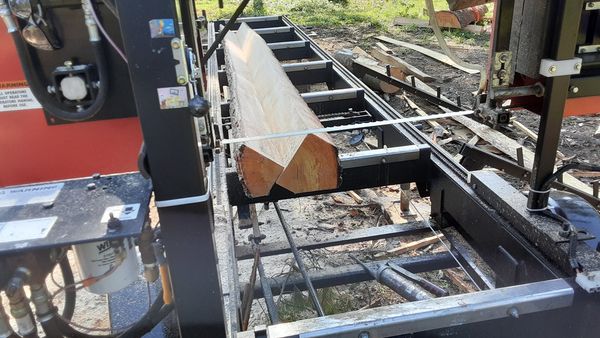
TimberKing’s not a bolt-together mill. It’s very precise and puts out very smooth-surfaced boards. In fact, one part of my hives requires a very rough surface so I have a machine to rough-up one face of some of the smooth-surfaced TimberKing boards.
I got the 1400 TimberKing mill with a log turner. I love it. I have no issues; the hand-crank is no problem. Everything’s good!
Business sustainability
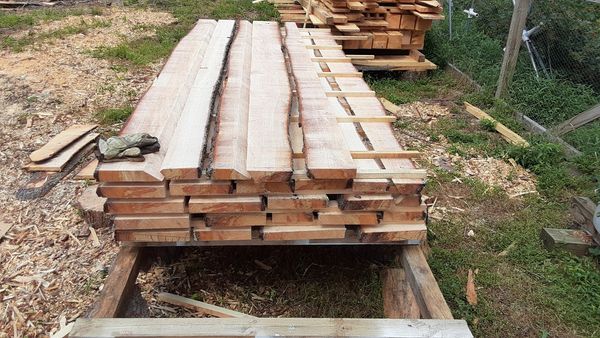
This mill gives me business sustainability. I fell my own trees – Eastern white pine – so the mill slashes my lumber costs. That means more profit margin. I make higher quality boards than I can buy and my production costs are down. I saw lumber exactly as I want it – precise, square and true with no knots. I even cut some quarter-sawn lumber.
TimberKing also has a refundable deposit plan. I put money down on a mill to lock-in a price, then watched the used mill market for about six months. I bought a used mill and got my deposit back. But it’s hard to find a used TimberKing and I found that most people selling theirs are trading up to a larger TimberKing.
Next goal: Increase production
Right now, I’m sawing lumber for my new, 40 x 60’ shop building. I plan to increase production to a larger scale and wholesale pallet-loads to distribution channels throughout New England and well beyond.
 If anybody out there’s looking at mills, here’s my advice. Forget Chinese mills. You might save $3,000 up front but get years of headache. A mill is a long-term investment and you want one that’s built in the USA, built to last, and gives you USA-based customer support like TimberKing.”
— Tom Bacon, TimberKing 1400 Owner, Union Bee Company, Union CT
HAVE QUESTIONS? 3 ways we can help you
• Call us 1-800-942-4406
• Email us [email protected]
• Visit us on Facebook